
-
About
-
Products
- By Timber Product
- Cladding
- Decking
- Joinery
- Screening
- Panelling
- View all
- By Application
- Exterior Cladding / Siding
- Exterior Rain Screen
- Exterior Roofing
- Interior Walls & Ceilings
- Soffits
- Screening, Fins & Battens
- Windows, Doors & Joinery
- Posts & Beams
- Accessories + Samples
- Coatings
- Fixings
- Samples
-
Shop
- Samples
- Timber Samples
- Architectural Sample Box
- View all
- Accessories
- Coatings
- Fixings
- View all
-
Resources
- By Resource Type
- Technical Data Sheets
- Guides & Manuals
- Technical Articles
- Profile Drawings
- View all
- How To
- How To Specify
- How To Install
- How To Maintain
- Projects
- Contact
Global Webinar / Passive House in Practice: From Build to Living. Find out more >





The Making of Abodo Vaaro® Fire
Vaaro began as an ambitious idea: to create a high performance timber cladding for use in high risk fire applications. What followed was an internationally coordinated R&D journey.
Today, Vaaro stands as a new class of feature timber, building on Abodo’s unrelenting determination to innovate which started long before the first board ever left the pilot plant.
Five Years in the Making
The early development of Vaaro was supported in part by New Zealand’s Ministry for Primary Industries (MPI), whose funding helped accelerate the research phase.
From the outset, the Abodo team understood that creating a product with advanced performance characteristics would require deep technical expertise and a global testing footprint.
Ben Campbell, Abodo Head of Innovation and Daan Olthuis, Abodo R&D Manager, worked closely with local and international testing partners to ensure that Vaaro’s credentials could be backed by rigorous, independently verified data. This commitment became a defining feature of the project.
Thanks to MPI’s ongoing commitment throughout the R&D phase, Abodo was able to grow capability locally and transform a pioneering idea into a globally significant timber innovation.
Triple Modified for Performance Locked in at a Cellular Level
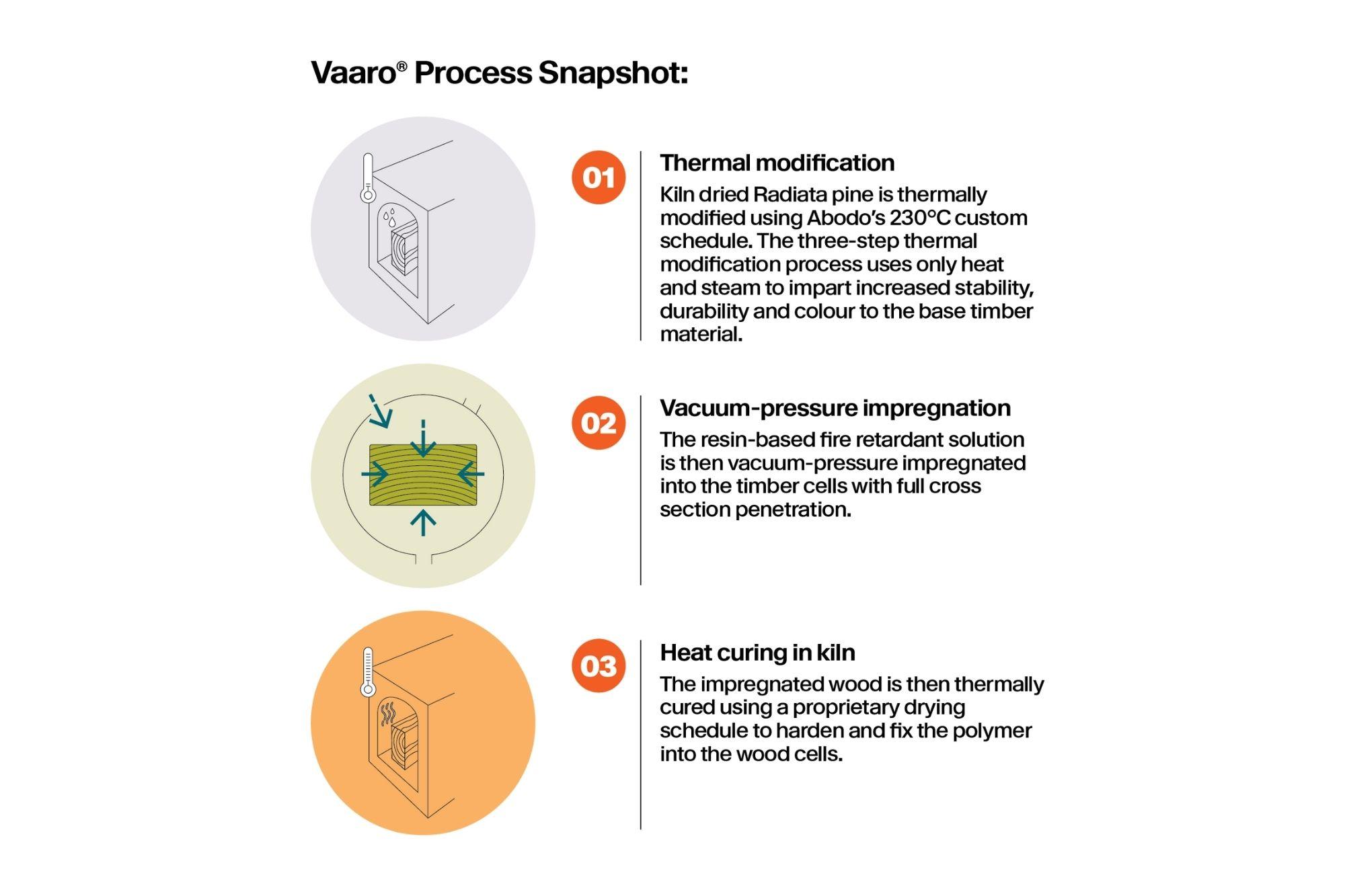
Made in New Zealand from Abodo’s signature heat tempered, rapidly renewable timber – Vaaro is then infused with a special resin-based, fire retardant treatment.
This resin utilises the same kind of technology used in high performance materials (think space-grade applications) – which is pressure impregnated into the timber and then cured at high temperatures to set everything in place.
Mastering the Complex World of Compliance
As Vaaro moved from concept to reality, the team navigated the intricate landscape of international fire standards across New Zealand, Australia, the UK and Europe, and the United States.
Distributor partners and testing providers including BRANZ in New Zealand, RISE in Sweden and QAI Laboratories in USA who were instrumental in this process.
Each region’s fire tests and compliance standards are markedly different. For example, European fire classification of cladding relies on the Single Burning Item (SBI) test according to EN 13823-1 that is a 1.5m high corner wall with a heat source placed in the corner.
In contrast the USA market calls for the E84 ‘tunnel test’ that is a 24 foot long horizontal wall section with a flame running up the face of the test material. In New Zealand and Australia the ISO 5660 cone calorimeter test is the required method for cladding, in this test a radiant heat source is applied to a small 100x100mm sample of the product.
Daan emphasises “A product of this kind which is used in high fire risk applications, must be fully supported by certified data. Our approach has been deliberately conservative, ensuring that every statement about Vaaro’s performance is supported by verified results.”
Meeting these different standards across international markets brings extra assurance to those specifying or approving Vaaro in fire zone applications.
Why Weathering Testing Matters
The challenge with fire retardant treated wood is the leaching of active ingredients when exposed to weather. Solving this challenge required finding a technology to lock the treatment in place.
This led to one of the most impressive chapters in Vaaro’s story; its weathering testing programme. Going beyond international standards the team designed a long-term natural weathering study, alongside accelerated weathering testing, spanning three continents.
- Accelerated Weathering
In controlled chambers, boards were exposed to cycles of water, UV, and heat to simulate years of outdoor exposure in a compressed timeframe in accordance with the ASTM 2898 standard that is called for in most markets. These accelerated weathering procedures emulate long-term exterior exposure, demonstrating excellent leach resistance properties.
- Natural Weathering
At the same time, exposure racks of Vaaro boards were installed at RISE, Sweden in accordance with EN927-3 standard where the product will continue to be tested in the years to come. In New Zealand boards in exposure are tested and audited by independent experts with the programme set to run into the future.
As a result of this extensive testing Vaaro conforms to the new European, USA and New Zealand requirements for exterior performance of fire retardant treated wood products including classification to EN 16755 DRF EXT INT1 INT2.
Putting the product through real-world natural weathering testing provides an additional level of confidence around performance, in addition to the accelerated testing programme.
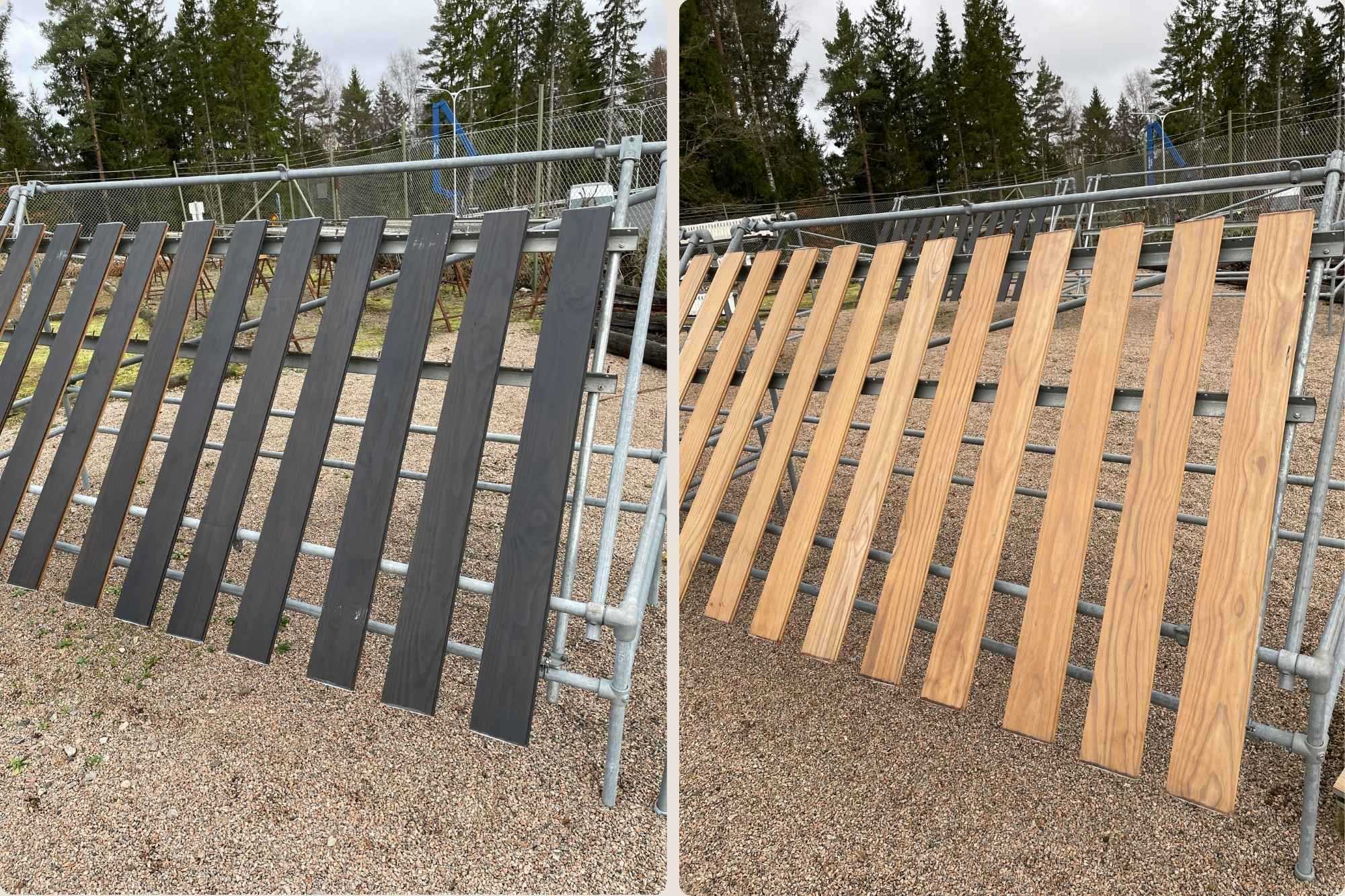
Coated and uncoated Vaaro boards on natural weathering racks at RISE, Sweden.
Density, Durability and Total Cost of Ownership
Vaaro’s enhanced density – around 650 kg/m³ compared to Vulcan’s 420 kg/m³ – gives it a noticeably harder, more robust feel.
Its durability performance aligns with well-known Class 1 durability hardwood species such as padouk, kwila (merbau) and higher than western red cedar, but with the added benefit of engineered consistency and sustainable sourcing (including FSC® certification). This means that Vaaro is offered with a 40 year durability warranty against fungal attack, subject to warranty conditions.
For exterior cladding, these properties of Vaaro timber mean longer service life, improved coating performance and reduced maintenance cycles – which in turn results in a lower total cost of ownership.
Engineered for Machining, Certified for Fire Compliance*
One of Vaaro’s most distinctive advantages is its ability to maintain performance even after machining (subject to conditions). Because the active ingredients are evenly distributed throughout the timber, customers can machine blanks directly (within certain strict specifications) without undermining the product’s fire compliance* classification.
This is a unique advantage of Vaaro: Abodo’s international distributor partners can stock blanks and machine them to profile as needed, allowing them to respond quickly and cost effectively.
It eliminates long lead times and reduces the risk of damage that can occur when fully profiled products are shipped from a single manufacturing site.
The Story Continues
Operations are scaling and the foundation is clear: Vaaro is a new kind of timber – ultra-durable, globally tested to major fire standards – setting a new standard in timber innovation.
Abodo Vaaro Fire is the only ultra-durable, fire compliant* timber available as a complete coated, tested product range - all from one trusted manufacturer.
* Vaaro has been tested to and has achieved AS/NZS 3837:1998 Type A and ISO 9705:2003 Group 1-S (NZ), AS 3959:2018 BAL29 and AS 5637.1:2015 Group 1 (AU), B-s2, d0 (LVG) / B-s1, d0 (Flatsawn) (EN 13501-1:2018) DRF EXT INT1 INT2 (EN 16755:2017) (UK+EU), and ASTM E84 Class A (USA) fire compliance standards.
Please note: images and profiles shown here may vary slightly from the finished product depending on regional availability.
Related Products
See more about the products that have been used on this project.
Related Articles
Abodo Vaaro® Fire – Frequently Asked Questions
Do you have questions about Vaaro, Abodo’s fire compliant* timber? Find the answers here.
WEBINAR / Inside Vaaro® Fire: Rethinking Fire, Design, and Material Innovation
This webinar explores how fire safety in architecture, changing global regulations and responsible low-carbon material specification are shaping the future of design - featuring Abodo’s Vaaro Fire.